Thursday, 13 November 2014

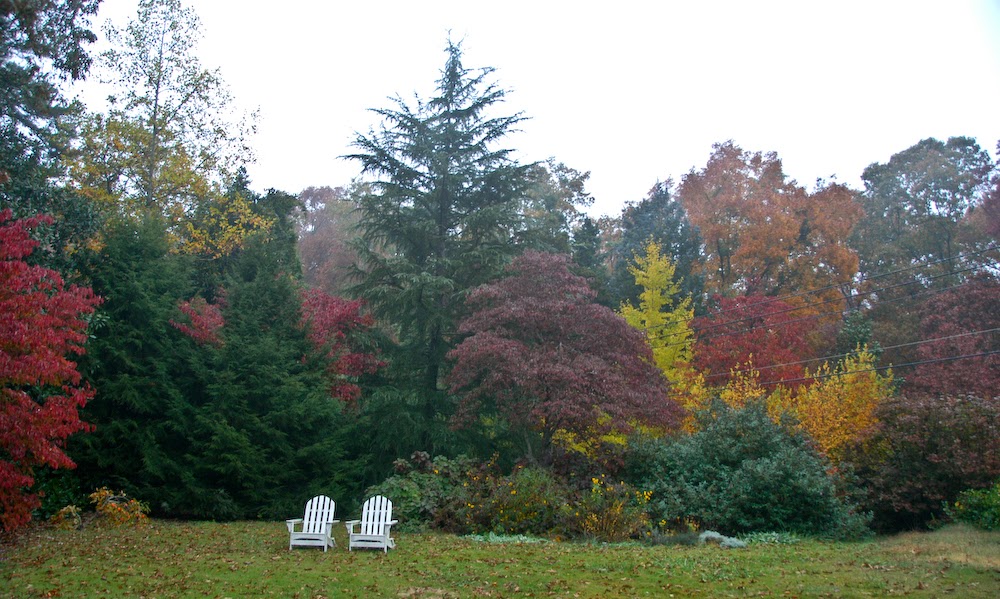
The fall colors keep coming...

Even in the mountains, there are still plenty of yellow and reds illuminating the landscapes.

In the Piedmont this morning, I felt like I was saying good-bye to fall color, but maybe not, even as the arctic cold front (and wind) descends this weekend.

oak-leaf hydrangea

gingko, sassafras, viburnum, and oaks

Fothergilla

Wednesday, 12 November 2014

Gingkos: with and without leaves


After the coming weekend's fall blast of cold air, unusual for mid-November, we won't have much fall color left.  I'm thinking the wind will bring down all of the yellow, orange, and red maple leaves, and probably most of the oak leaves, too.

A touchstone of our seasonal lives in the Eastern US is fall color -- mainly from native trees, but also from ancient trees, with a heritage far different.

Gingkos fall in that category. A Chinese temple tree, extinct in the wild, they've been planted widely along streets and in landscapes. Their fall color glows a luminous yellow, and their leaves fall all at once, carpeting the surrounding ground.

Tuesday, 11 November 2014

Ginkgos

In the mountains of Western North Carolina, the late October snow brought down all of the ginkgo leaves, before they'd turned their characteristic luminous yellow.

In the piedmont of South Carolina, the leaves are starting to turn right now.  The smaller of the two trees in the garden where I used to work (and taught a class today) is a clear, wonderful yellow.

Here's an image from a couple of years ago that looks (close to) what I saw today.


In our backyard, the vivid yellow isn't quite yet there  -- hopefully, we'll see it if the arctic air that's coming our way doesn't zap those leaf abscission layers (that's what seemed to happen in the mountains).


Monday, 10 November 2014

A look back

Amazing to search for sassafras (which is a vivid color right now) in older posts, and pick up this post from several years ago - on this date.

It's remarkable to see how much larger some of these trees are -- even just three years later (we've had a LOT of rain).

http://naturalgardening.blogspot.com/2011/11/more-fall-color.html

http://naturalgardening.blogspot.com/2011/11/more-fall-color.html

The sassafras is the deep red to the right of the yellowing ginkgo (and above the yellow-leaved viburnum) on the right side.

Kalmias moving into the landscape

ready to plant
Mountain laurels are tricky -- they need perfect drainage and exactly the right site to be "at home" in a new spot. We've lost plenty over the years, when they weren't in the right spot!

Old mountain laurels persist for decades, of course, and are perfectly sturdy in their (natural) well-drained habitats.

a bushy, field-grown mountain laurel
Several found new homes in our mountain landscape last weekend, thanks to my gardening companion.  Hopefully, on the lower slope, they'll thrive!  It's well-drained, for sure.

Sunday, 9 November 2014

Saturday, 8 November 2014

Nettles

I've been following a group that's interested in Celtic traditions and stories, and was surprised to see nettles pop up, as a touchstone plant in the first story.

It's nutritious as a pot-herb, but also valuable (historically) as a fiber plant, and as a plant with story-meaning, too.
Nettles are interesting and widespread. They're native to a good chunk of the world (http://en.wikipedia.org/wiki/Urtica_dioica) in North America and Europe, but they're certainly prolific in other places, too (in overgrazed areas around Masai dwellings in Tanzania, for example).

I saw a patch recently in a pasture (at Biltmore Estate). It was prolific and spreading.  It echoed an overgrazed spot, I'm thinking.
nettle patch
fall view at Biltmore