Monday, 4 March 2013

Is native gardening a fairy tale?

Grassleaf Barbara’s Buttons (Marshallia graminifolia)
are beautiful Florida natives suitable for any fairy tale garden…

Once upon a time, a gardener decided that she wanted more butterflies and more birds in her yard. She read books and oodles of online material and then she attended classes, conferences, workshops, and garden fests. After all this education, she found that she really could make a big difference by installing native plants that attract butterflies and birds with their berries and delicious leaves that caterpillars would eat. As a bonus her landscape would be easy to care for since native plants have lived in the wild for eons with no care at all.

After a great quest* far and wide across her realm, she found a local native plant nursery that had the native plants she wanted. She paid the small bounty for the plants and brought them home and everyone (and every bird and butterfly) lived happily ever after. 

NOT! 
Continue reading to find out what happens next...

The other day, my husband cut the lawn for the first time since early November.
I was sorry to see the toadflax (Linaria canadensis) go, but that's what happens in a freedom lawn--whatever is growing gets mown. I did rescue some St. John's wort seedlings, though.  More on that later.
I hope you've allowed your lawn to host natives along with the turf--it's so much more sustainable.

Green Gardening Matters,
Ginny Stibolt


Saturday, 2 March 2013

The first rain lily of spring

Three days before this lovely rain lily (Zephyranthes atamasca) emerged, we received 1.8" of rain. Hence the common name...

These lovely native plants are in the amaryllis family and mostly grow in damp ditches. We often see them along roadsides because that's where people and damp ditches most frequently come in close contact.

A couple of years ago, I initiated a rescue of some of these lilies along a roadside near my house. The road was slated to be widened and these lovelies would be buried. I applied to county for a permit, but it took so long to receive permission that by the time I could get a crew together for the rescue, with permit in hand, the ditch had been mowed and the lilies were no longer obvious. I had paced out the the location, so we had somewhere to start, but we were shooting in the dark.  We did find some bulbs and later we planted in local parks and wild lands.  You can read about it here: Rescuing Rain Lilies.

Here is a photo of the last spring for these roadside rain lilies before the construction began.
I use this as my screensaver graphic on my computer as a reminder of how important it is to be an activist.
The weather is cold again this weekend, so maybe our cool-weather veggies will make it to maturity so we can harvest them before the heat of summer sets in. I hope your gardens are growing well.

Green Gardening Matters,
Ginny Stibolt

Thursday, 28 February 2013

Cool vs. warm season vegetables and herbs

In an herb-gardening class this morning, I had a lovely participant that had recently moved to South Carolina from upstate NY. 

It was a great reminder (for me) of what a wonderfully benign climate that we have in the Carolinas for growing herbs and vegetables!

Our average last spring frost date ("historically" April 15) is really more like April 8 (or earlier) now.  And we've moved from Zone 7b to Zone 8, in the Piedmont of South Carolina.

In the mountains of Western North Carolina, where I spend time in the summer and on weekends, in the Asheville basin (where our small house is), we're now Zone 7 b, instead of Zone 6, and I'm sure the 'heat island effect' along with the stone raised beds that I have, bump that up!

Needless to say, even as we're moving into true spring, I'm harvesting the last overwintered arugula (it's starting to bolt) as I'm planting spring cool-season seeds, too, and thinking about transplants of warm-season vegetables to come.

Amending vegetable beds in the satellite garden (a couple of years ago)
A Master Gardener volunteer, who enjoyed the Hawaiian Pineapple tomatoes last year (that I did, too) asked via email today if we would have transplants for them at our spring sale.  Well, no, I replied, as we've rearranged how we grow transplants, but I then ordered seeds, and will share, for sure!

Tuesday, 26 February 2013

Mud

I'm grateful for the rain, truly.  It's refilled our upstate SC lakes, hydrated the soil in the mountains, but...

The path past the main vegetable garden (from the kitchen door) is becoming a compacted, muddy mess with all of the rain.

We fell into the habit of using the kitchen garden/mud room door while our sweet rescue Golden, Woody, was recovering from knee surgery last fall (the 'taking the dog out' excursion...) There's just a small step down through the door verge there.

But, now he's fine, and we're continuing to use that path.

Hmm, perhaps he needs to use the steps down from the bedroom door, or out the front door, as alternative "step" exercises!

Friday, 22 February 2013

Tulips are emerging

Hmm, if I'd been energetic (which I'm not, still recovering from a bad cold), I'd have pictures of the tulips emerging in front of our house in the mountains.

We didn't plant them, the previous owner (and designer of our small house) did.  He wasn't a gardener, at all, but his tulips have been lovely over the last springs.  The colors coordinate with our house -- how nice is that!

This was last year's post about their appearance.

The tulip foliage looks great and robust so far --we'll see what the flowers are like this year.

This is what they looked like a couple of years ago.

Tulips at the base of the house

Wednesday, 20 February 2013

Looking forward to spring vegetables!

I'm doing a program this weekend about "creating an attractive and sustainable vegetable garden" and it has me thinking hopefully about spring vegetables.

I'm feeling behind on sowing seeds and getting started due to travel and a bad cold, so am ready for thinking positively about lettuce, spinach, beets, arugula, mustards, peas, etc. -- all the spring possibilities that can be totally successful (and delicious) depending on the vagaries of late winter/early spring weather.

I've STILL got offset baby leeks to transplant, but hopefully they'll catch up quickly when I have time and energy to do that.  I managed to get in onion seedlings and transplants this afternoon, but they suffered a bit from a delay in planting (due to my being under the weather), so it'll be interesting to see how they fare.

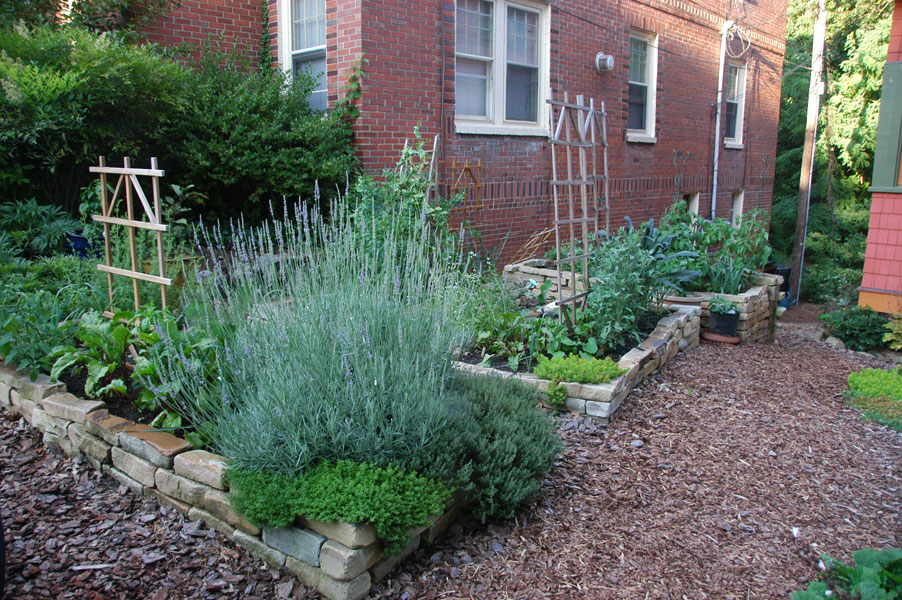
In the meantime, this view of June raised beds in the mountains last year cheered me up!

Raised beds in June

Sunday, 17 February 2013

February

The downie woodpeckers have been visiting the suet feeders (note to self, put suet cakes on the grocery list).

Yes, I could make homemade suet for them, but I'm already making (homemade) bread, granola, and yogurt for us --hmm, and keeping Woody from helping himself from cooling bread on the counter!

Hmmrph.  He managed half a loaf this afternoon.

It's been great fun to watch spring coming along (and winter blasting back, too).  I was going to put onion seedlings in the ground this afternoon, in spite of suffering with a bad cold, but quickly realized that the top inch or so was still frozen.  Hmm, I guess I'll wait for both onion seedlings and dormant onions!